

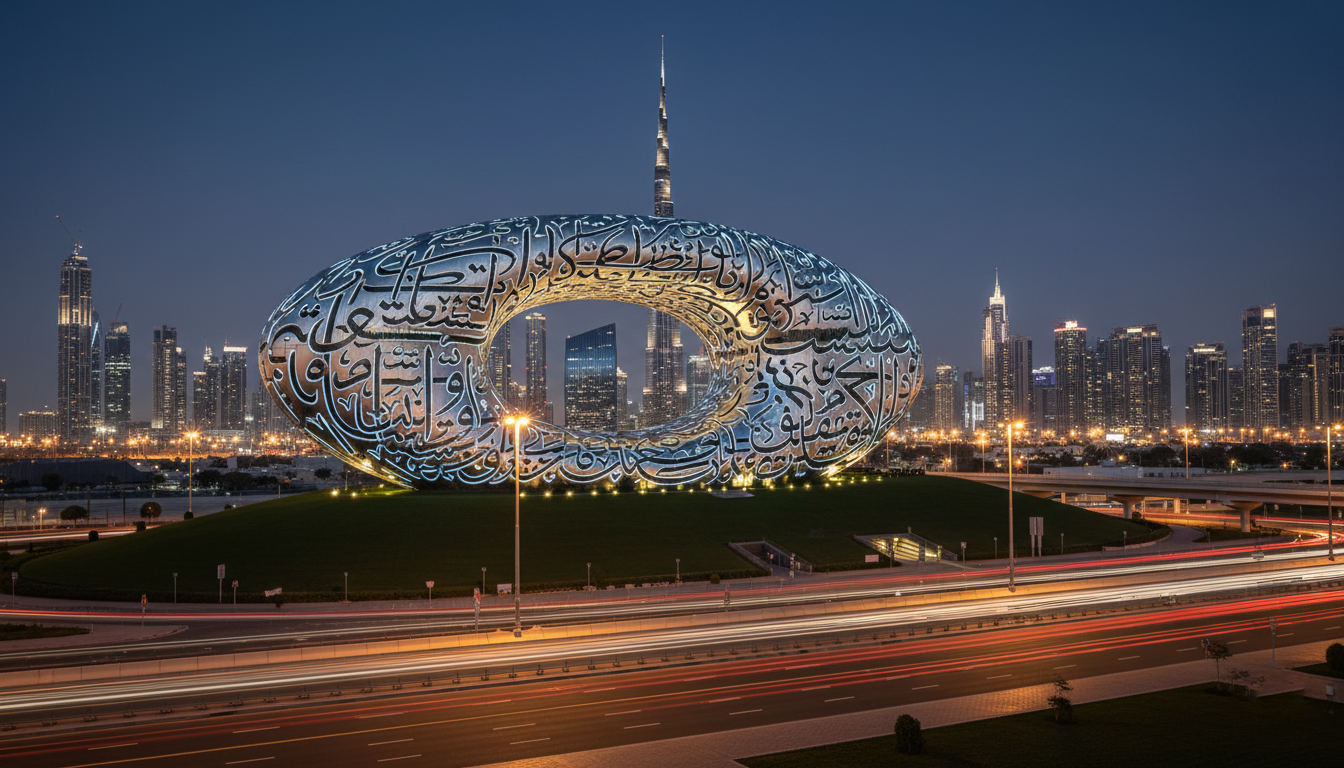
There's a version of Dubai that most visitors never fully see. Not the towers, not the malls, not the marina sunsets but the version that asks harder questions about time, identity, memory, and what comes next. That version lives inside the city's museums. And in 2025, the museum scene here has grown into something genuinely worth building an itinerary around.
According to Dubai's Culture and Arts Authority, cultural site visits in the emirate increased by over 22% between 2022 and 2024, with international tourists under 35 driving the sharpest growth. The appetite for substance not just spectacle is reshaping how people spend their time in the UAE. From a 3-dirham history lesson inside a 200-year-old fort to a 149-dirham journey through the year 2071, Dubai's museum offer spans more registers than most cities three times its size. Knowing where each one fits makes the difference between a rushed afternoon and an experience worth remembering.
The museum of the future Dubai where the city shows its ambitions
No building in Dubai has generated more conversation in recent years than the one on Sheikh Zayed Road shaped like an eye. The museum of the future Dubai opened in February 2022 and has remained one of the most visited cultural sites in the UAE ever since. It's exterior a torus form covered in Arabic calligraphy cut directly into the steel facade is worth seeing after dark, when the illuminated script reflects off the road below and the building seems to hover rather than stand.
What you'll find inside the exhibitions
The museum of future Dubai is not a traditional museum. There are no display cases, no timelines on walls, no artifacts behind rope barriers. Instead, the building is divided into experiential environments set in the year 2071 a fictional space station orbiting Earth, a regenerated Amazon ecosystem, a Dubai of the future reconstructed from the ground up, and a series of meditation and contemplative spaces in the lower floors. Visitors move through these environments at their own pace, and the quality of the production design is consistently high throughout.
The experience runs between 2 and 3 hours at a comfortable pace. It rewards visitors who read the framing text in each space rather than rushing through for photographs alone. The final floors a quiet, almost therapeutic set of rooms focused on consciousness and the human body tend to be the most unexpectedly affecting part of the visit for adults.
Museum of the future Dubai tickets and practical planning
Museum of the future Dubai tickets are priced at AED 149 per adult, with children under 3 admitted free. Future museum Dubai tickets are available through the official website at motf.ae and should be booked at least three to five days in advance during peak season (October through April). Weekend slots, particularly Friday afternoons, sell out with consistent regularity. The museum der zukunft Dubai as it's known among German-speaking visitors opens daily from 10 AM to 6 PM, with extended Thursday evening hours.
Among the indoor attractions in Dubai that consistently receive five-star reviews across all major platforms, this one leads the category both for the architecture and for the ambition of what's inside.
The Dubai Museum in Al Fahidi the oldest story in the city
Before there were towers, there was a creek. Before there was a creek district, there was a fort. The Dubai Museum inside Al Fahidi Fort in Bur Dubai predates almost everything else visitors see in the emirate, and the contrast between what it represents and what surrounds it today is part of what makes it so worth visiting.
The bur Dubai museum sits inside the oldest surviving building in the emirate, dating to 1787. The Dubai museum bur Dubai location is straightforward to reach Al Fahidi metro station is a five-minute walk and the surrounding Al Fahidi Historic District rewards a longer exploration before or after the museum itself. Wind-tower houses, courtyard galleries, and tea houses cluster around the fort in a way that feels genuinely preserved rather than artificially restored.
The Dubai museum ticket price is AED 3 for adults and AED 1 for children, making it one of the most accessible things to do in Dubai for free adjacent experiences in the city. For that entry fee, visitors move through life-size dioramas of traditional Emirati life pearl-diving boats, a reconstructed desert encampment, a traditional souk, a working date palm farm alongside archaeological artifacts and photographs documenting Dubai's transformation across the twentieth century. The experience runs 60 to 90 minutes and functions as an essential primer for everything else the city offers.
Art, illusions, and immersive experiences across the city
Museum of illusions Dubai and Arte Museum
The museum of illusions Dubai approaches its subject with complete commitment to fun. The illusion museum Dubai is built entirely around optical tricks, gravity-defying rooms, and installations that produce photographs your friends genuinely won't believe without an explanation. It occupies a compact space in the city center and delivers its specific experience laughter, confusion, and strong social content within 60 to 90 minutes. Museum of illusions Dubai tickets cost AED 95 for adults and AED 75 for children, with family bundle options available at the entrance and online. For visitors who want to balance a cultural day with something more physical the following morning, jet ski in Dubai along the Jumeirah coastline makes a natural contrast the transition from the stillness of a museum to an open stretch of Gulf water at speed is one of the more satisfying swings of pace the city allows.
Arte museum Dubai takes the immersive format into fine art territory. Floor-to-ceiling projections of works by Monet, Van Gogh, Klimt, and Hokusai move and breathe around you with original soundtracks a format borrowed from acclaimed venues in Seoul and Paris, executed here with genuine scale. The Dubai art museum category has historically been less defined than in other global cities, but Arte Museum has established itself as one of its clearest reference points, particularly for visitors who find traditional galleries difficult to engage with. It works well for children from around age 5, as the visual richness holds attention without requiring art knowledge.
Specialty collections and gallery culture
The gallery culture centered on Alserkal Avenue in Al Quoz represents the more serious end of Dubai's art scene. Over 50 independent galleries and studios operate across this converted industrial district, with free entry to most and programming that changes monthly. The Jameel Arts Centre in Jaddaf Waterfront anchors the contemporary end with strong rotating exhibitions, a permanent collection, and a waterfront sculpture garden that's particularly pleasant in the cooler months. Both are strong places to visit in Dubai for visitors who want to see what the city produces culturally, beyond the headline attractions.
The specialty museums worth your afternoon
Dubai has built a category of focused, intimate museums that rarely appear on mainstream lists but consistently surprise the visitors who find them. The coffee museum Dubai in Al Fahidi is one of the most pleasant a beautifully restored traditional courtyard house dedicated to the history of Arabic coffee, with free entry and tastings included. It pairs naturally with a morning at the Al Fahidi Historic District and the nearby spice souk.
The car museum Dubai formally known as the Emirates Classic Car Museum near Al Quoz holds a well-curated collection of vintage and collector vehicles in an air-conditioned space. The museum of candy Dubai is newer and occupies a different end of the spectrum: interactive, highly visual, and designed primarily for families and younger visitors looking for something tactile and photogenic. It's not educational in the traditional sense, but it delivers a cheerful hour with children.
For visitors interested in the UAE's political formation, the Etihad Museum near Jumeirah fills the gap that the Al Fahidi site leaves open. The building itself is designed to reference the document signing that established the UAE in 1971, and the exhibits are well-produced and chronologically clear. It sits among the more underrated indoor attractions in Dubai for culturally curious adults.
Planning your Dubai Museum visit a full day that works
A well-structured museum day in Dubai can combine the historical and the futuristic without feeling rushed, if you plan the geography sensibly. The city's museum sites spread across several districts, so a little sequencing goes a long way.
Here's a practical overview of the main sites, prices, and recommended visit durations:
| Museum Adult ticket (AED) Location Visit duration | |||
| Dubai Museum (Al Fahidi Fort) | 3 | Bur Dubai | 1–1.5 hours |
| Museum of the Future | 149 | Sheikh Zayed Road | 2–3 hours |
| Arte Museum Dubai | 95 | Downtown Dubai | 1–2 hours |
| Museum of Illusions Dubai | 95 | City center | 1–1.5 hours |
| Coffee Museum | Free | Al Fahidi | 30–45 minutes |
| Jameel Arts Centre | Free | Jaddaf Waterfront | 1–2 hours |
| Etihad Museum | 25 | Jumeirah | 1–1.5 hours |
| Car Museum Dubai | 25–35 | Al Quoz | 1–1.5 hours |
A few things worth knowing before you go:
- Book museum of the future Dubai tickets online do not rely on walk-up availability on weekends
- The Al Fahidi cluster (Dubai Museum, Coffee Museum, Historic District) forms a natural morning itinerary under AED 20 per person total
- Most Dubai museums close on specific public holidays; Eid schedules are not always announced far in advance, so check directly before visiting
- Photography is generally permitted across venues, with specific restricted zones in the Museum of the Future
- Children under 3 enter the Museum of the Future free; confirm child policies at other venues before purchasing family tickets
After a full museum day, a quick search for a restaurant near me in Dubai near Al Fahidi will surface Lebanese, Emirati, and South Asian options within walking distance many open late and price comfortably after a low-spend cultural afternoon.